Hidden runtime use
Dynamic libraries, vendor binaries, and actual protocol behavior can differ from the static picture.
For security and platform teams with regulated Linux estates
Laviq gives your team runtime evidence of active cryptography, the context to prioritize what should change, and a defensible starting point for post-quantum migration planning.
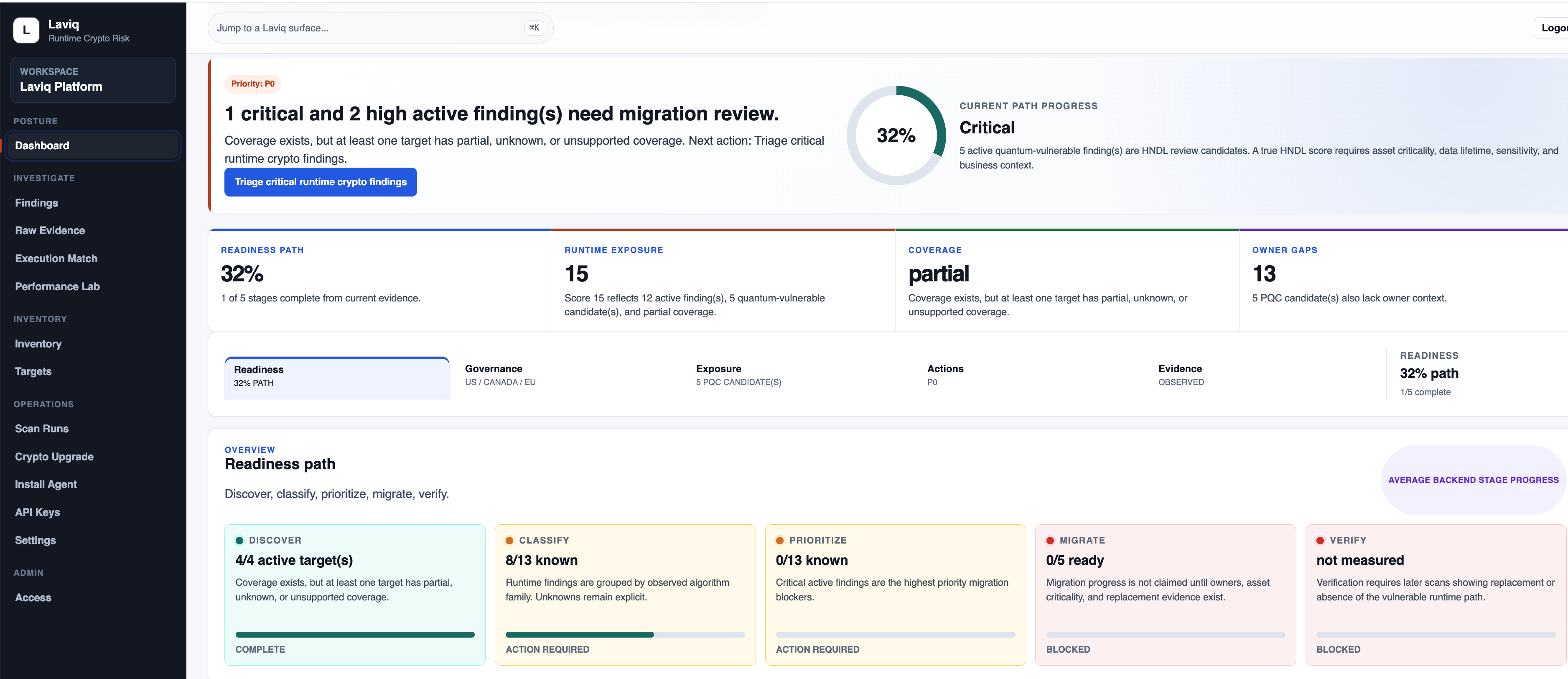
The decision path
Start with the path that executes today. Laviq carries that evidence into the context your security and platform teams need to decide what changes first.
Explore the evidence model →What crypto, process, and applicable network behavior were captured.
Findings, ownership, coverage, and relationships for a focused review.
Selected matching traffic can be evaluated for a policy-driven protection path.
Explanatory model · screenshots elsewhere on this page are real Console captures.
The decision gap // 01
Dependencies, certificates, and configuration remain useful inputs, but they do not prove which crypto executes in a workload, who owns it, or whether it matters for the migration path.
Dynamic libraries, vendor binaries, and actual protocol behavior can differ from the static picture.
Without workload, owner, coverage, and network context, a crypto list does not tell a team what to change first.
Legacy systems and vendor dependencies can make immediate application remediation slow, risky, or unavailable.
The Laviq assessment // 02
The engagement starts with a focused workload, produces explicit evidence and coverage context, then turns that work into a prioritized review path.
Establish runtime crypto and applicable network evidence with process and implementation context from a scoped Linux workload.
Bring findings, inventory, correlations, performance, ownership, and coverage into a single migration conversation.
Document practical next steps: application migration candidates, open evidence gaps, and selected-flow protection questions for design partners.
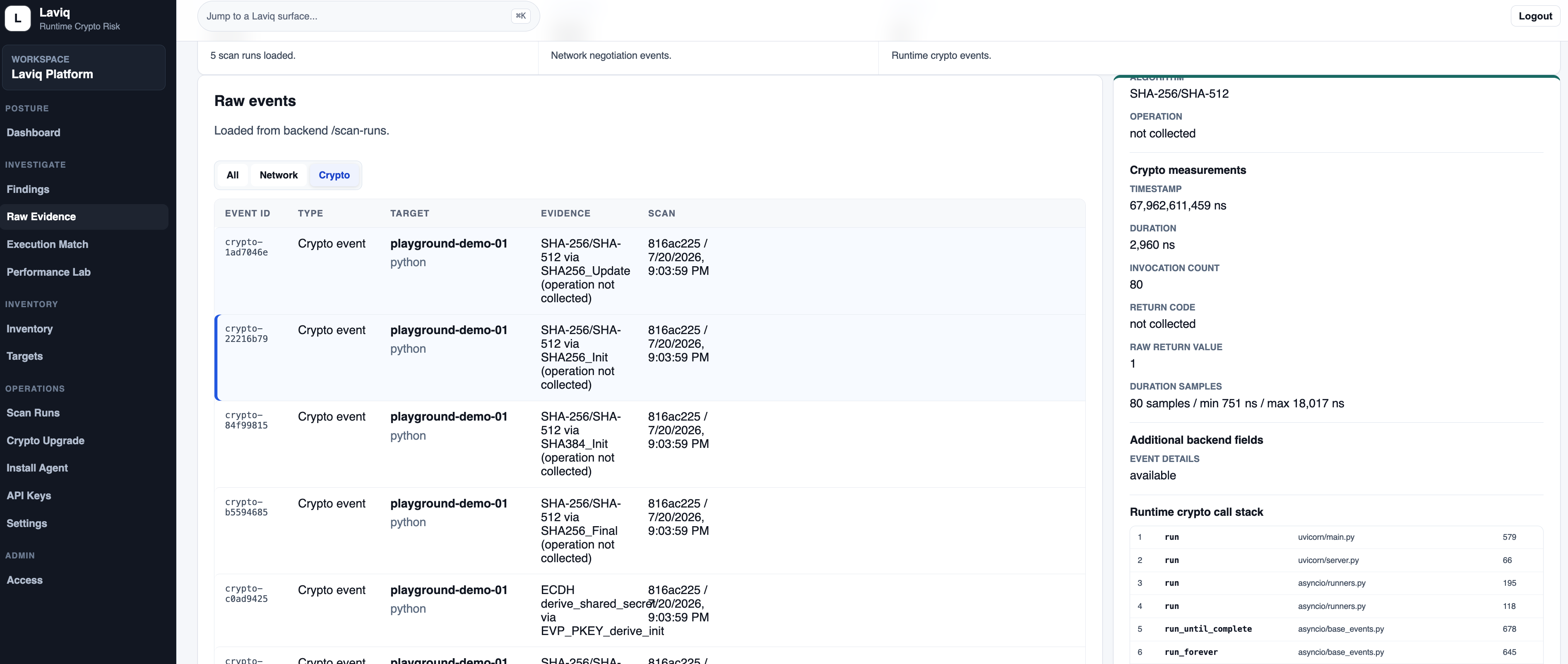
What Laviq proves
The console keeps the proof trail visible: what was observed, where it ran, which implementation was involved, and which evidence gaps remain.
Use cases // 03
Use cases describe the buyer question Laviq helps answer. They do not turn a static list or a concept diagram into proof.
Where to start
Choose a critical service, a vendor-controlled component, or a path with material long-term exposure.
Start from active findings, coverage, ownership, and workload context rather than a dependency list that may not represent runtime use.
Use observed runtime evidence when source access is partial, unavailable, or insufficient for the question.
Bring an evidence-backed view of active behavior, open coverage gaps, owners, and next actions into the migration discussion.
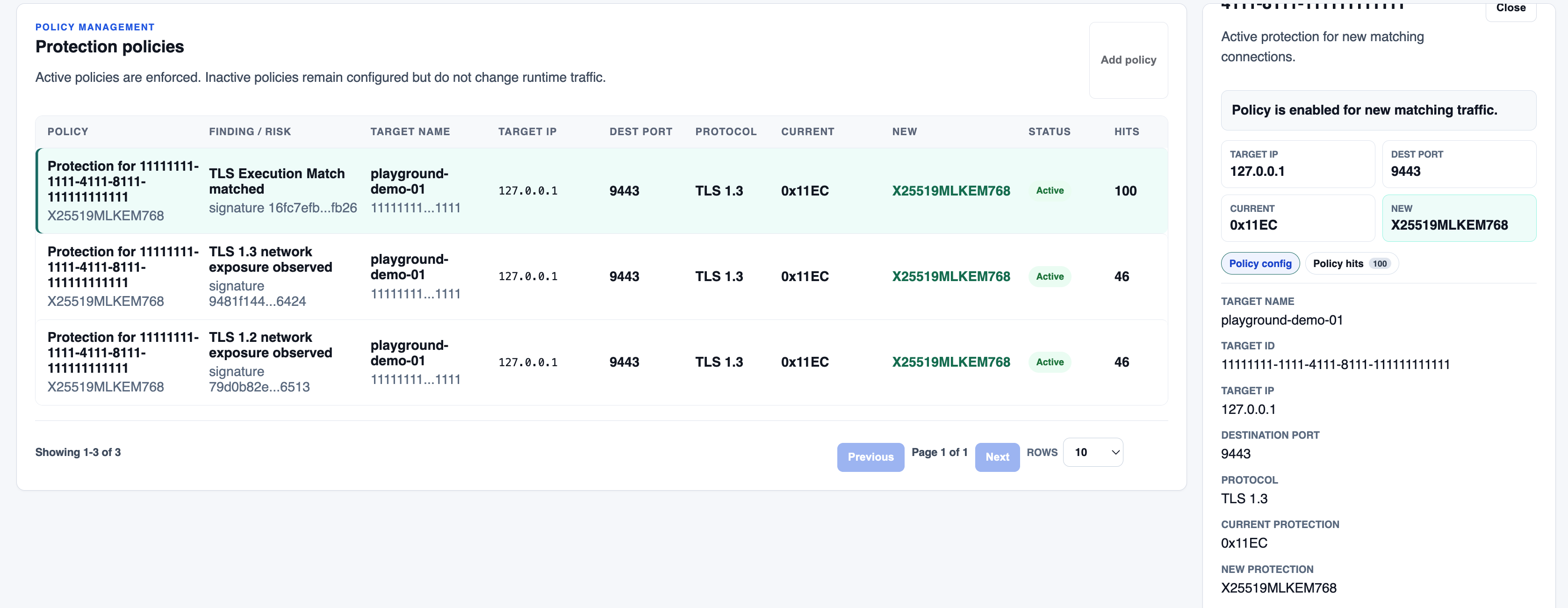
Selected-flow protection
Protection policies can be configured for selected matching connections. The console makes the target, current configuration, and proposed protection visible for review.
This capability applies to new matching traffic; it is not a claim that every communication path is protected.
Design partners
Tell us about the Linux workload, vendor dependency, or migration question that needs a clearer evidence path. We will scope the right starting assessment with you.